
Chicago Heights Directory Holdings
The documented Chicago Heights city directory shelf is useful but not continuous. The strongest published inventory is the Illinois State Geological Survey local-history holdings guide. It identifies named publishers and specific runs associated with the Chicago Heights Public Library. Treat those dates as holdings leads, then confirm the exact volume, format, and availability with the library before a visit. No official open scan of a complete local directory was located.
| Collection | Years | Where Held | Access |
|---|---|---|---|
| Hayne and Moore city directories | 1905–06; 1908–09 | Chicago Heights Public Library holdings guide | Confirm shelf or microfilm access |
| McDonough directories | 1916; 1923–27 | Chicago Heights Public Library | Ask a librarian or visit the History Room |
| Directory Service and Calumet volumes | 1937; 1941 | Chicago Heights Public Library | Confirm exact volume before travel |
| Haines and criss-cross runs | Various 1980s–90s | Library local-history material | Reverse address research in person |
| Regional Chicago directories | 1871–1917; 1923; 1928–29 | South Suburban Genealogical & Historical Society | Non-circulating reference use; verify closure |
The sequence has large breaks. Nothing in the research proves annual publication between the listed runs, identifies a first edition before 1905, or establishes the final printed year. An absent name in 1910 or 1930 may reflect a missing volume, not an absent resident. Phone books, newspapers, census schedules, and deeds can bridge the gaps, but each source answers a different question.
Chicago Heights Directory Eras
The publisher names form a practical timeline. W.J. Hayne & Co. appears for 1905–06, S.H. Moore for 1908–09, and McDonough for 1916 and 1923–27. Directory Service marks 1937, followed by Calumet Directory in 1941. Much later Haines and criss-cross books change the search from a chiefly alphabetic name tool to an address-oriented one.
| 1905–09 | Hayne and Moore runs provide the earliest located local starting points. |
|---|---|
| 1916–27 | McDonough volumes help follow families through the industrial-growth years. |
| 1937–41 | Directory Service and Calumet bridge the prewar period. |
| 1980s–90s | Haines and criss-cross material supports reverse address searches. |
Chicago Heights incorporated in 1892, while Cook County land and vital systems are older. Earlier families may therefore appear under Bloom Township, a parish, a county record group, or a nearby place label before they appear in a city volume. The timeline is a guide to where to look, not proof that publication began or ended on these dates.
Chicago Heights Records History Room
The Chicago Heights Public Library at 25 W 15th Street is the main local access point. Its site offers catalog search, Ask a Librarian, and local-history routes. Listed hours are Monday noon to 7 p.m., Tuesday through Friday 10 a.m. to 5 p.m., and Saturday 10 a.m. to 2 p.m.; call 708-754-0323 to confirm.
Ask for a publisher and year, not just “old directories.” Staff can verify whether a volume is on a shelf, on microfilm, or temporarily unavailable. The library also holds local maps, clippings, industrial surveys, Manufacturers Association Papers, and Chicago Heights Star and Signal microfilm. No public item-level directory or obituary database was verified, so the reference desk, phone, and in-person History Room are real access channels.
The library homepage shows how to reach its catalog and reference help. View the Chicago Heights Public Library source before using the local-history collection.
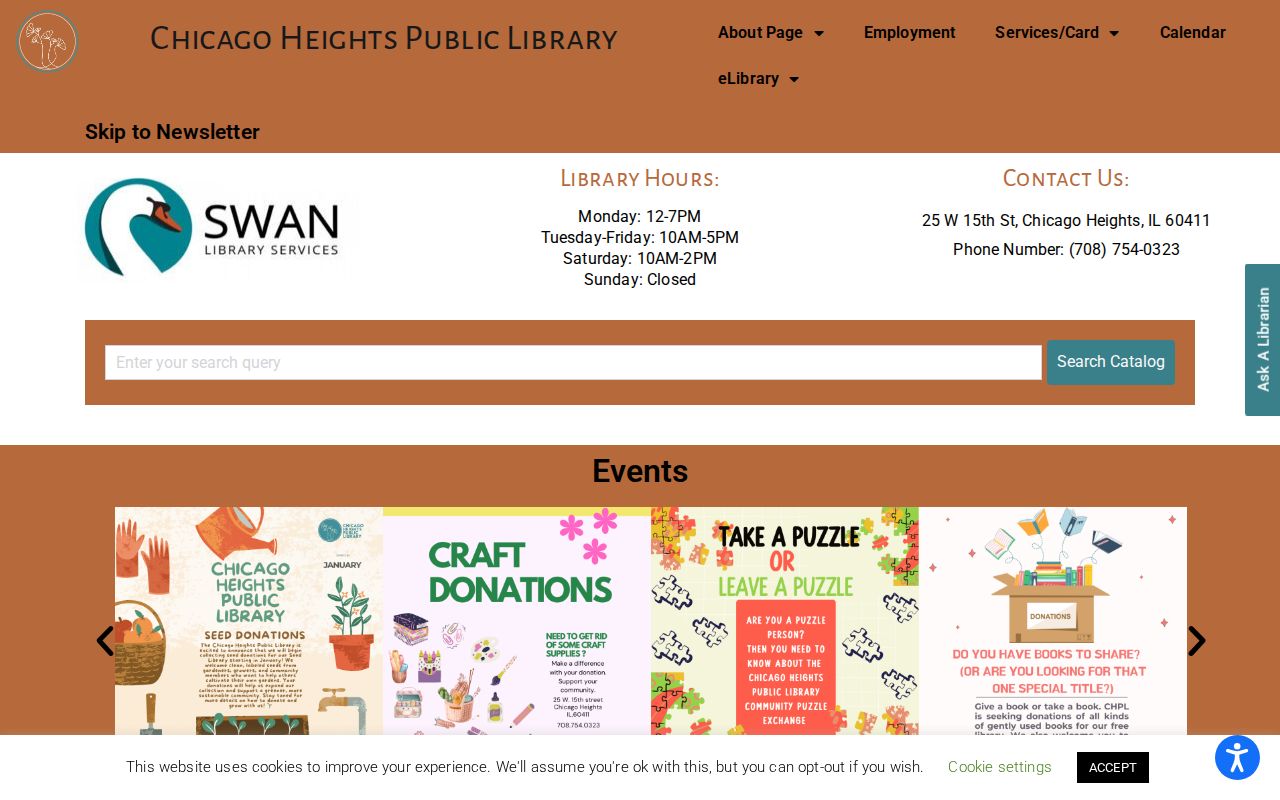
This image identifies the official library starting point; the detailed year list still comes from the holdings guide and should be checked with staff.
Note: Ask whether licensed genealogy databases are available on site, because the public pages did not confirm a current subscription.
Chicago Heights Records Genealogy Shelf
The South Suburban Genealogical & Historical Society collection provides a second shelf when Chicago Heights city directories leave gaps. Its Hazel Crest reference library reports more than 14,000 non-circulating items, Chicago directories, census material through 1950, a naturalization index, local newspapers, yearbooks, church histories, family files, and a 93-cemetery master index with about 62,500 names.
The society is at 3000 W 170th Place, Hazel Crest, with 708-335-3340 and info@ssghs.org as contact channels. Its current notice says the library is closed until further notice because of storms, so call or email before relying on posted hours. The closure makes remote questions, the Chicago Heights library, and Illinois archive routes more important.
The captured holdings page gives a sense of the regional depth. Review the SSGHS collection description before framing a focused request.
The society complements local volumes with cemetery, census, naturalization, and family-history material rather than replacing the Chicago Heights shelf.
Read Chicago Heights Directory Entries
No official digitized Chicago Heights sample entry was found, so do not invent a local abbreviation. Inspect the key printed in the same volume before expanding any mark. A careful transcription records the page, publisher, year, town section, initials, punctuation, and the precise address line. It also notes whether the page is alphabetic or reverse-order.
| Name | Surname, given name, initials, and sometimes a spouse or household note. |
|---|---|
| Address | House number and printed street label, preserved exactly as shown. |
| Work notation | Historical occupation or business affiliation when the publisher included it. |
| Household mark | Possible owner, renter, widow, or boarding notation, decoded only from that volume’s key. |
| Phone field | A telephone number in phone-book or combined runs, not proof of later residence. |
- Criss-cross directory
- A volume arranged by street and house number so an address can lead to a listed name.
- Householder index
- An address-oriented list of the person the publisher treated as the main household listing.
- Abbreviation key
- The publisher’s legend for shortened words and status marks. Save it with every transcription.
Chicago Heights Resident News Sources
Telephone books are a separate historical layer. The holdings guide lists 1913, 1928, 1941, 1944, 1947, 1950, and various runs from 1970 onward. A phone book may supply a number and address when a directory year is missing, but unlisted households and business-only entries make it incomplete.
Newspaper microfilm adds dated evidence. The library lists the Chicago Heights Star from 1906 onward and the Signal for 1911–13. Search obituaries, wedding notices, civic reports, and advertisements, then compare the finding with a directory, deed, census schedule, or eligible vital record. No verified public online obituary index was found.
Names may shift across these sources. Chicago Heights history includes Italian, Polish, Slovak, Lithuanian, Irish, and African American communities, so initials, maiden names, spelling changes, and Anglicized forms deserve separate searches. Preserve the spelling each source used instead of merging similar names.
Map Chicago Heights Directory Addresses
Sanborn fire-insurance maps give the building and block context that a directory line lacks. The Library of Congress provides free Chicago Heights volumes for 1897, 1911, and 1950. Library holdings also report paper maps for 1911–56.
A map can show a footprint, street label, lot pattern, or building use. It cannot name the occupant. Chicago Heights grew around rail, industry, and the Lincoln Highway route, and no official street-renumbering table was located. If a directory address vanishes, compare sheets and nearby directory years, then use the parcel PIN or legal description to bridge old and current labels.
Note: Cite the map year and sheet, since a later update may show a different structure at the same printed address.
Chicago Heights Records History Network
Chicago Heights has an unusual three-part history network. The Historic Preservation Advisory Committee says the city has no separate historical society. The committee, local library, and regional SSGHS collection therefore serve different roles: landmarks and home-history leads, primary local material, and broader genealogy references.
The Historic Preservation Advisory Committee is a volunteer city committee established in 1996. It can point toward landmarks, photographs, historic homes, and house-tour context, but it is not a resident index. For older county records, the Illinois archival repository description, IRAD, and Cook County Archives remote reference extend the chain when local shelves stop.
Make each request narrow. Give the library a publisher and year, ask SSGHS for a named collection and surname, or send an archive the record group and date span. For landmark research, provide the street address and the building or institution name. Hotel Victoria, Bloom High School, Inland Steel, and the Lincoln Highway are useful catalog terms rooted in local history. They may lead to yearbooks, industrial surveys, newspapers, preservation files, or maps. A name found in one of those sources remains a dated historical reference. Confirm it against a second collection before joining it to a household or later address.
Collection gap. No open, complete Chicago Heights city directory scan was verified. Ask for a named year and publisher instead of assuming the whole run is online.
Trace Chicago Heights Directory Families
A sound family-history trail treats each Chicago Heights city directory as one dated source. Begin with the most certain name or address, then move one available year at a time. The 1950 census is the latest generally released federal schedule, so pair it with close directory, phone-book, newspaper, and map dates rather than forcing exact year matches.
- Find the earliest certain entry by exact name, initials, or an address in a reverse volume.
- Record the publisher, year, page, printed spelling, household notation, and address without expanding abbreviations.
- Check the next available run and note moves, absences, street-label changes, or a new household notation.
- Compare the nearest released census, deed, phone book, or newspaper notice. Seek two independent points of agreement.
- Use cemetery, naturalization, church, obituary, or eligible vital channels to close a historical relationship trail.
Disappearance alone proves little. The person may have moved, died, gone unlisted, changed a surname, or fallen into a publication gap. SSGHS cemetery and naturalization material, Star or Signal microfilm, and Cook County genealogy forms can test those possibilities. For a modern address search, use the separate Chicago Heights street directory workflow rather than treating a historical listing as current.